Azure Lab Services Alternatives for Schools, Colleges & Universities: Compare the Best Replacement Options in 2026
Compare Azure Lab Services alternatives for 2026 and find the right fit for your labs, LMS, VM images, costs, and 2027 migration plans.

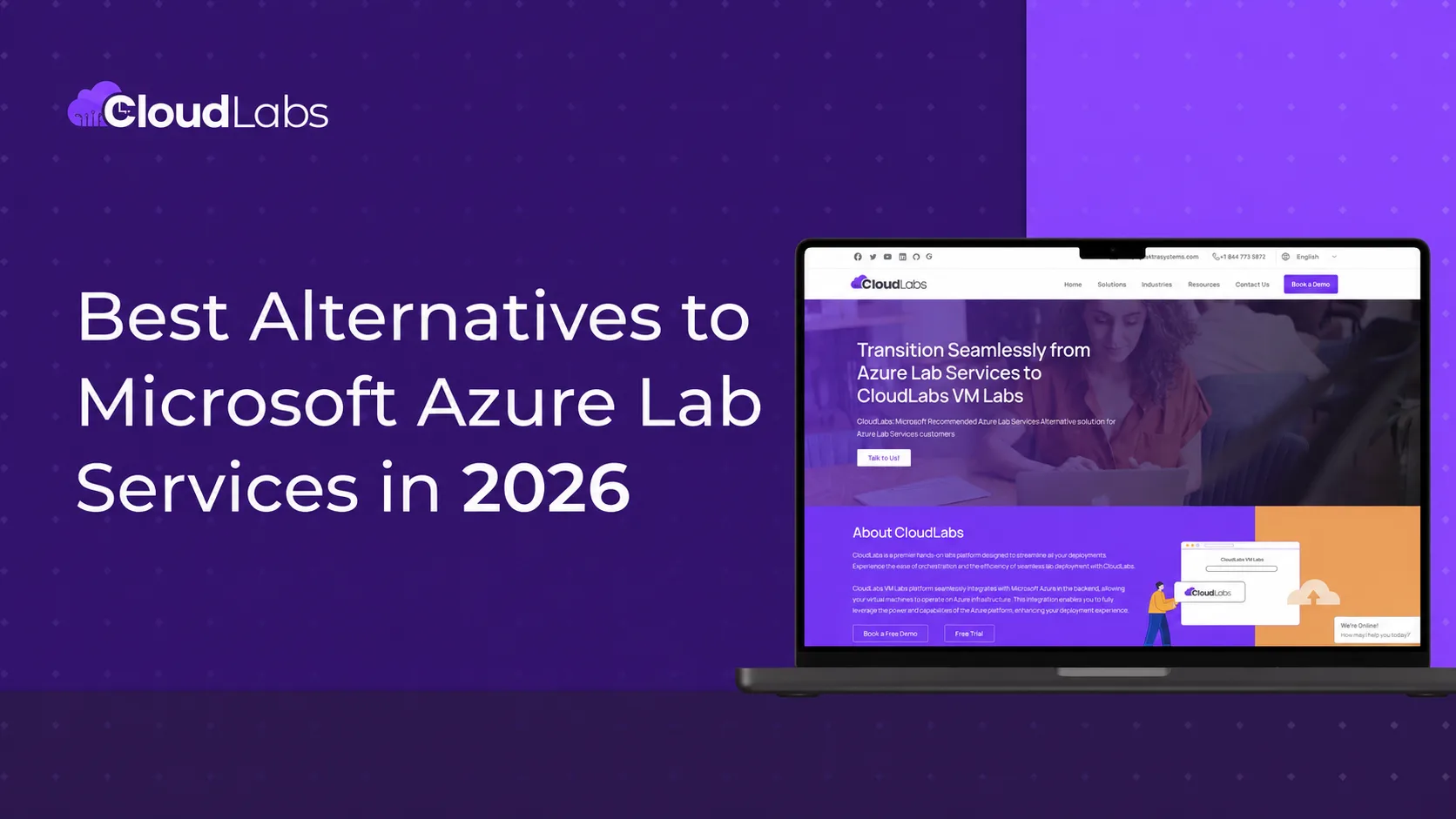
The best Azure Lab Services alternatives depend on who will run them. For schools, colleges and universities, Microsoft recommends three managed lab platforms: Apporto, CloudLabs VM Labs and Skillable. Institutions with Azure administrators can build on Azure Virtual Desktop (managed with Nerdio for Windows labs), Windows 365 or Azure DevTest Labs. Azure Lab Services retires on June 28, 2027, so Fall 2027 classes need a replacement that’s already been piloted.
This guide compares three managed lab platforms and four build-it-yourself paths on Azure against the six requirements an institution would have: LMS integration, VM images, cost, administration, accessibility, privacy. Each entry says who it fits and names at least one limitation. CloudLabs VM Labs is our product, and we say so where it appears. For the best fit by situation, see “Azure Lab Services Alternatives at a glance” below. A timeline at the end works back from the Fall 2027 term to the budget request you may need to file this year.
For a step-by-step migration guide, see our step-by-step migration guide.
How to choose an Azure Lab Services Replacement
Choosing an Azure Lab Services replacement is about more than comparing features. The right option needs to fit your existing courses, technical requirements, budget, and the way your organization manages hands-on learning environments.
We recommend looking at six areas: classroom controls, LMS launch, existing VM images, cost per student, accessibility and privacy, and ongoing administration. Together, these factors can help you determine which option is the best fit.
1. Classroom controls: Can you set schedules, quotas, and a cap on each learner’s hours? Without per-learner limits, one student who leaves a VM running can drain a course budget. Members of Microsoft’s Q&A community have pointed out that some Azure services don’t offer per-learner hour caps out of the box. Test it: ask the vendor to set a 10-hour limit for one student in a live demo.
2. LMS launch: Can students open labs from Canvas, Moodle, or your LMS, without a separate portal? Microsoft notes its recommended partners support LMS integration, but that none of the alternatives offer Teams integration; the workaround is to post the lab URL in a Teams channel. Test it: launch a lab from a test course in your own LMS.
3. Existing VM images: After retirement you keep your Azure compute gallery and the images saved in it, and Microsoft says all its recommended solutions can use or migrate those images. But Azure Lab Services exports only specialized images, and some platforms need generalized ones. Test it: migrate one real course image during the pilot.
4. Cost shape: Is pricing by consumption, per named user, per concurrent user, or a flat subscription? One detail catches people out: Microsoft says Azure Lab Services covers storage as a complimentary service, so a replacement quote that adds storage isn’t like for like. Test it: get a cost per student for one real course, storage included.
5. Accessibility and privacy review: Most US colleges need these before any pilot with students. Ask every vendor for an accessibility conformance report (VPAT) and FERPA documentation up front, so procurement doesn’t stall your spring pilot.
6. Who operates it: A managed platform runs the infrastructure for you. A Microsoft service built in your own tenant leaves quotas, scaling, images and student support to your team. For organizations evaluating a replacement, understanding who will manage the environment after implementation can be just as important as the feature set.
Azure Lab Services Alternatives at a Glance: Best Fit by Situation
Who will run it decides the best fit more than any feature checklist. Start with one question: do you have Azure administrators who can build and maintain the environment?
If the answer is no, a managed lab platform is the shortlist. If it’s yes, pick the Microsoft service that matches your lab type.
| Your situation | Best-fit option |
|---|---|
| You teach cloud, cyber or data courses that need real Azure resources beyond VMs (containers, Kubernetes, data and AI) and scored assessments | Skillable |
| You need browser-based computer labs for large cohorts on a fixed cost per concurrent user | Apporto |
| You want Azure Lab Services’ classroom model plus multi-VM labs (up to 5), non-persistent labs, instructor VM Shadow and per-user cost reports, and have no cloud engineers | CloudLabs VM Labs |
| You run Windows lab desktops and already have Azure Virtual Desktop and Azure admins | Nerdio Manager for Enterprise (on Azure Virtual Desktop) |
| You have Azure admins and want shared Windows or Linux desktops in your own tenant, scripting quotas yourself | Azure Virtual Desktop |
| You need one persistent cloud PC per named user at a subscription price | Windows 365 Cloud PC |
| You run dev/test-style engineering labs and will script per-learner hour limits | Azure DevTest Labs |
Managed Lab Platforms Microsoft Recommends for Education
For customers who want something similar to Azure Lab Services, Microsoft’s retirement guide recommends a small group of Azure partners (Apporto, CloudLabs VM Labs and Skillable) that, in its words, specialize in education-focused solutions.
Microsoft says these support Linux, nested virtualization and multi-VM environments, over-the-shoulder monitoring, admin or non-admin student access, and LMS integration, and that all of its partner solutions run on Azure with a choice of region.
1. Apporto: Best for browser-based computer labs for large cohorts on a fixed cost per concurrent user
What it is
Browser-based virtual desktops and labs, listed as a recommended partner in Microsoft’s retirement guide. Apporto’s managed tier runs Windows, Linux and Mac desktops; its self-managed Basics tier runs Windows and Linux.
What it does well
According to Apporto’s own page:
- A virtual classroom where instructors can view all student screens at once, with hand-raising and screen sharing
- LMS integration with Blackboard, Canvas, D2L and Moodle
- A managed tier whose per-user fee includes infrastructure, compute, storage and network charges
- Single-session and multi-session desktop configurations
Limitations
- The managed price is a range of $27 to $101 per concurrent user, with no tier criteria or worked example on the page, so you can’t estimate cost without a quote sized to your peak concurrency.
- Apporto’s page doesn’t mention multi-VM labs or nested virtualization, so confirm support if your courses need them.
Fits
Large cohorts that need browser-based desktops at a fixed cost per seat. Doesn’t fit: teams that want to estimate cost from a published price before talking to sales.
Price
Apporto Basics at $12 per named user per month on your own Azure subscription, plus your Azure consumption; or the managed tier at $27 to $101 per concurrent user per month, infrastructure included.
2. CloudLabs VM Labs: best for keeping Azure Lab Services’ lab model while adding multi-VM labs, non-persistent labs and per-user cost reporting
What it is
A managed lab platform that runs on Azure, listed as a recommended partner in Microsoft’s retirement guide. See CloudLabs VM Labs for Azure Lab Services customers.
What it does well
According to CloudLabs’ own comparison with Azure Lab Services:
- Up to 5 VMs per lab (Azure Lab Services: 1), each with its own configuration
- Persistent and non-persistent labs
- Custom vCPU, RAM, GPU and disk sizes per lab
- Instructor VM Shadow for watching a learner’s live session (not available in Azure Lab Services)
- Lab lifecycle tracking, and Power BI cost reports per user and lab
- LTI 1.1 and LTI 1.3 for launching labs from Canvas and Moodle
Beyond colleges, the same platform covers corporate training, GPU-based software training and large hackathons.
CloudLabs VM Labs vs. Azure Lab Services
| Capability | Azure Lab Services | CloudLabs VM Labs |
|---|---|---|
| Lab deployment | Managed classroom labs | Managed classroom labs |
| VMs per lab | 1 VM per lab | Up to 5 VMs per lab, with individual configurations |
| Persistent labs | Supported | Supported |
| Non-persistent labs | NA | Supported |
| VM configuration | Predefined Azure VM sizes | Custom vCPU, RAM, GPU and disk configurations |
| Instructor monitoring | Not available. Basic VM controls only | VM Shadow for real-time instructor visibility |
| LMS integration | LMS integrations supported | LTI 1.1 and LTI 1.3 for Canvas and Moodle |
| Cost visibility | Azure-based usage model | Per-user and per-lab Power BI cost reporting |
| Lab lifecycle management | Lab and lab-plan management | Lab lifecycle tracking and management |
| Student access | Managed student access | Managed student access with configurable lab access |
| Usage controls | Scheduling and usage quotas | Scheduling and per-user usage quotas |
Limitations
- Azure compute is billed pay-as-you-go on top of the per-user platform fee, so total cost moves with usage. It isn’t a flat price.
- Image carry-over still needs a pilot. Microsoft’s caveat about specialized images applies here as everywhere, so test your own course images before committing.
Best for
Institutions that want a managed Azure-based lab environment with classroom controls, LMS integration and multi-VM support without building the entire lab-management layer themselves.
Host
- GPU-based software training
- Large-scale hackathons
- Isolated testing environments
Pricing
CloudLabs uses a platform fee plus Azure compute, with pricing varying based on the subscription model and resource usage. See current CloudLabs pricing for details.
3. Skillable: best for cloud, cyber and data courses that need real Azure resources and scored assessments
What it is
A lab platform listed as a recommended partner in Microsoft’s retirement guide. Beyond VMs, Skillable says it can deploy “any Azure resources for temporary usage,” with each user’s lab in a dedicated resource group.
What it does well
According to Skillable’s own comparison with Azure Lab Services:
- Real Azure resources beyond VMs, cleaned up after use
- LTI 1.3, REST API and SCORM support for delivering labs through an LMS or your own platform
- Activity-based assessment inside labs, and performance-based testing to validate skills
- Access over standard web ports only, rather than RDP and SSH (Skillable’s claim)
Limitations
- Skillable runs two portals, Studio for lab builders and admins and TMS for instructors and students, which is more to learn for a two-person team.
- Its comparison document dates from September 2024 and doesn’t cover pricing, migration help or higher-ed features.
Fits
Cloud, cybersecurity and data programs that grade hands-on work. Doesn’t fit: general computer labs that only need a Windows or Linux desktop.
Price
Not published.
Build-it-yourself Azure options: Azure Virtual Desktop, Windows 365, DevTest Labs and Dev Box
Microsoft names these services itself, and for an institution with a cloud team they are legitimate replacements. Microsoft says they aren’t necessarily education-specific but support a wide range of education and training scenarios. While the platform cost may be based on Azure consumption, organizations also need to account for the operational effort required to manage quotas, scaling, images, and student support.
4. Azure Virtual Desktop: best for full control in your own Azure tenant when you will script quotas yourself
What it is
Microsoft’s virtual desktop service, with usage-based pricing, CPU and GPU VMs joined to Microsoft Entra ID, content filtering, images from the Azure Marketplace or your compute gallery, and management through Intune.
What it does well
Multi-session desktops, where several users share one VM. Microsoft notes this can reduce the number of cores you need, which is the main cost lever.
Limitations
A community answer in Microsoft’s Q&A forum notes there’s no built-in per-learner hour limit, so you’d script one yourself (a forum answer, not Microsoft documentation). Multi-session also needs multi-session images from the Marketplace, and Azure Lab Services’ specialized image exports need converting to generalized images first. Microsoft recommends a partner management tool on top of Azure Virtual Desktop for Windows lab scenarios, but that still leaves you running an Azure Virtual Desktop environment.
Fits
Institutions with Azure administrators.
Doesn’t fit
A one- or two-person team without cloud experience.
5. Windows 365 Cloud PC: best for one persistent cloud PC per named user at a subscription price
What it is
A Cloud PC per user that Microsoft describes as highly available and scalable, with predictable subscription pricing, joined to Microsoft Entra ID, and managed with Intune.
What it does well
Simple to budget per person, and familiar to Windows admins.
Limitations
Windows 365 is licensed per user, per month, at a fixed price regardless of how many hours each user is signed in (Windows 365 plans and pricing). That works for people who use the same desktop all term. For courses where students use a lab for only a few hours a term, you pay the full monthly license for each of them.
Fits
Staff or students who need the same desktop all term.
Doesn’t fit
Large classes with short, occasional lab sessions.
6. Azure DevTest Labs: best for dev/test-style engineering labs where you will script per-learner hour limits
What it is
An Azure service for creating development and test environments. Despite the similar name, it’s a different product from Azure Lab Services.
What it does well
Usage-based pricing and auto-shutdown controls for VMs.
Limitations
Community answers in Microsoft’s Q&A forum note it has no per-learner hour tracking without custom automation, and nothing points to built-in LMS launch.
Fits
Engineering programs comfortable with scripting.
Doesn’t fit
Instructor-led classes that need quotas and LMS launch out of the box.
7. Microsoft Dev Box: best for developer workstations, not classroom labs
What it is
Cloud developer workstations. Microsoft notes Dev Box requires Dev Box-supported Marketplace images, so existing lab images may not carry over.
Limitations
Built for professional developers, with per-user pricing that adds up for large classes.
Fits
Software development programs that want full developer environments.
Doesn’t fit
General computer labs.
When to Decide: The Timeline to Fall 2027
Microsoft’s retirement date isn’t your only deadline. Your budget cycle, testing window, and first course launch on the replacement platform should determine when you start the transition.
What Microsoft has set:
- New Azure Lab Services sign-ups closed on July 15, 2024.
- Existing labs, lab plans, and lab accounts remain available until June 28, 2027.
- After retirement, customers will lose access to their Azure Lab Services resources, while saved Azure Compute Gallery images remain accessible.
- For institutions targeting Fall 2027, the replacement should be selected and piloted well before the first course launch.
A rough timeline, working backwards from Fall 2027
Every institution moves at its own pace, so treat these as typical ranges, not fixed dates. The one date that doesn’t move is June 28, 2027.
| Stage | Typical length | What happens |
|---|---|---|
| 1. Discovery | 3 to 6 weeks | List every course that uses Azure Lab Services, with its VM images, VM sizes and student hours. Decide who will run the replacement, and submit the budget request. |
| 2. Evaluation | 4 to 8 weeks | Shortlist two or three options, see demos, and ask each vendor for accessibility (VPAT) and FERPA documentation. |
| 3. Proof of concept (POC) | 1 to 4 months | Test one or two real courses on the shortlisted platform: your images, your LMS, ideally your students. |
| 4. Contract | 4 to 8 weeks | Procurement, accessibility and privacy review, legal sign-off. |
| 5. Implementation | 2 to 3 months | Migrate or rebuild images, connect the LMS, set schedules and quotas, and train instructors. |
Working back from a Fall 2027 go-live: implementation starts by about April 2027, the contract is signed by early April, the POC runs in the first months of 2027, and discovery starts now. Move any summer sections before June 28, 2027.
If your POC or procurement usually takes longer, start discovery earlier. At the long end of these ranges, the process takes about a year, so a college starting now is already on a tight schedule.
Rebuild or Migrate Your Azure Lab Services Labs?
Not every Azure Lab Services environment needs to be moved exactly as it is. Depending on the complexity of your existing labs, VM images, and course requirements, you may find it more practical to rebuild some environments and migrate others.
Rebuild when…
- Your labs are relatively simple and can be recreated without significant effort.
- You want to update the VM configuration, lab settings, or base images as part of the transition.
- Existing images are outdated or you are changing the way the lab is structured.
- Starting with a clean environment is faster than adapting the existing setup.
Migrate when…
- You have complex or difficult-to-recreate custom VM images.
- Multiple labs depend on existing images or configurations.
- Rebuilding the environment would require significant time from instructors or IT teams.
- You want to preserve existing lab environments and reduce the amount of work required before moving to the replacement platform.
For CloudLabs VM Labs, existing VM images can be migrated using the CloudLabs migration script, while existing labs can be migrated using the CloudLabs migration tool. You can also choose a fresh setup when rebuilding is the better fit for a particular lab.
How CloudLabs VM Labs helps with your Azure Lab Services migration
- Images and labs: A migration script for VM images and a migration tool for existing lab accounts and lab plan labs
- Cost per student: Power BI reports per user and per lab (question 4)
- Classroom controls: Schedules and per-user usage quotas, plus VM Shadow for helping a stuck student in real time
- LMS launch: LTI 1.1 and LTI 1.3 compatibility for Canvas and Moodle
- Privacy: Voucher-based access designed so CloudLabs doesn’t collect or store student identities
- Operations: A managed platform with 24/7 support, so your team isn’t running the infrastructure
- Pilot: A 30-day free trial to test with your own courses before Spring 2027
For colleges and universities, see CloudLabs for K-12, colleges and universities.
Get the CloudLabs VM Labs Migration Playbook
Ready to turn your Azure Lab Services migration into a clear, structured plan?
The free 2026 CloudLabs VM Labs Migration Playbook gives you a practical framework to assess your readiness, choose the right transition path, plan your migration, and prepare your team for cutover.
Inside the playbook, you’ll find:
- A 10-question migration readiness check
- Guidance on choosing the right transition path for each lab
- A clear breakdown of how VM images and labs are migrated
- Azure subscription options with example pricing
- A 9-phase migration plan from preparation to cutover
- A practical pre-cutover checklist to help your team prepare
Download the free CloudLabs VM Labs Migration Playbook (2026 Edition)
Moving from Azure Lab Services? Get Up to $2K in Azure Credits
Transition to CloudLabs VM Labs with up to $2,000 in Azure Credits available to qualified customers. Use the credit toward eligible CloudLabs VM Labs usage under the program terms and begin piloting or rolling out your replacement environment without upfront costs.
Your migration includes:
- Up to $2,000 in Azure Credits for eligible CloudLabs VM Labs usage
- Full access without feature gating or forced minimums
- Expert guidance throughout the migration
- Flexibility to start with a pilot or full program rollout
See how CloudLabs VM Labs fits your courses. Start a free Proof of Concept (POC) and evaluate the platform in your real environment.
Offer eligibility and terms apply.
FAQs
Can I keep using Azure Lab Services until it retires?
Yes. Existing labs, lab plans and lab accounts keep working until June 28, 2027, with fixes for blocking bugs and security issues. New sign-ups closed on July 15, 2024, but subscriptions that used the service between July 2023 and July 2024 count as existing customers and can still create a new lab plan.
Will my VM images carry over to a replacement?
Your Azure compute gallery and saved images stay accessible after retirement, and Microsoft says all its recommended solutions can use or migrate gallery images. Azure Lab Services exports only specialized images, though, and Azure Virtual Desktop needs generalized ones. Microsoft suggests deciding image by image whether to migrate or rebuild.
Is there a drop-in Microsoft replacement?
No single one. Microsoft points to Azure Virtual Desktop, Windows 365, DevTest Labs and Dev Box, which it says aren't necessarily education-specific, alongside its recommended partner platforms.
Do these options work with Canvas?
Microsoft says its recommended education partners support LMS integrations such as Canvas, as well as delivery through a REST API or shareable URLs. CloudLabs VM Labs supports Canvas and Moodle through LTI 1.1 and LTI 1.3. Whichever option you shortlist, confirm your LMS and LTI version with the vendor before the pilot.
Are small programs too small for the partner platforms?
No. Some platforms work best for large deployments, so ask each vendor about minimums before you shortlist. CloudLabs VM Labs publishes its per-user fee, so you can estimate cost at any size. It also offers a 30-day free trial for testing with your own courses.
 Education How to Migrate from Azure Lab Services: Step-by-Step Migrate from Azure Lab Services before June 28, 2027: choose to rebuild or migrate, move VM images first, then labs in batches, and verify before cutover.
 Azure Microsoft Azure Lab Services Retirement: What It Means for You & How to Plan Your Transition Azure Lab Services retires June 28, 2027. See what stops working, what survives, and a 9-phase plan to move your labs before the deadline.
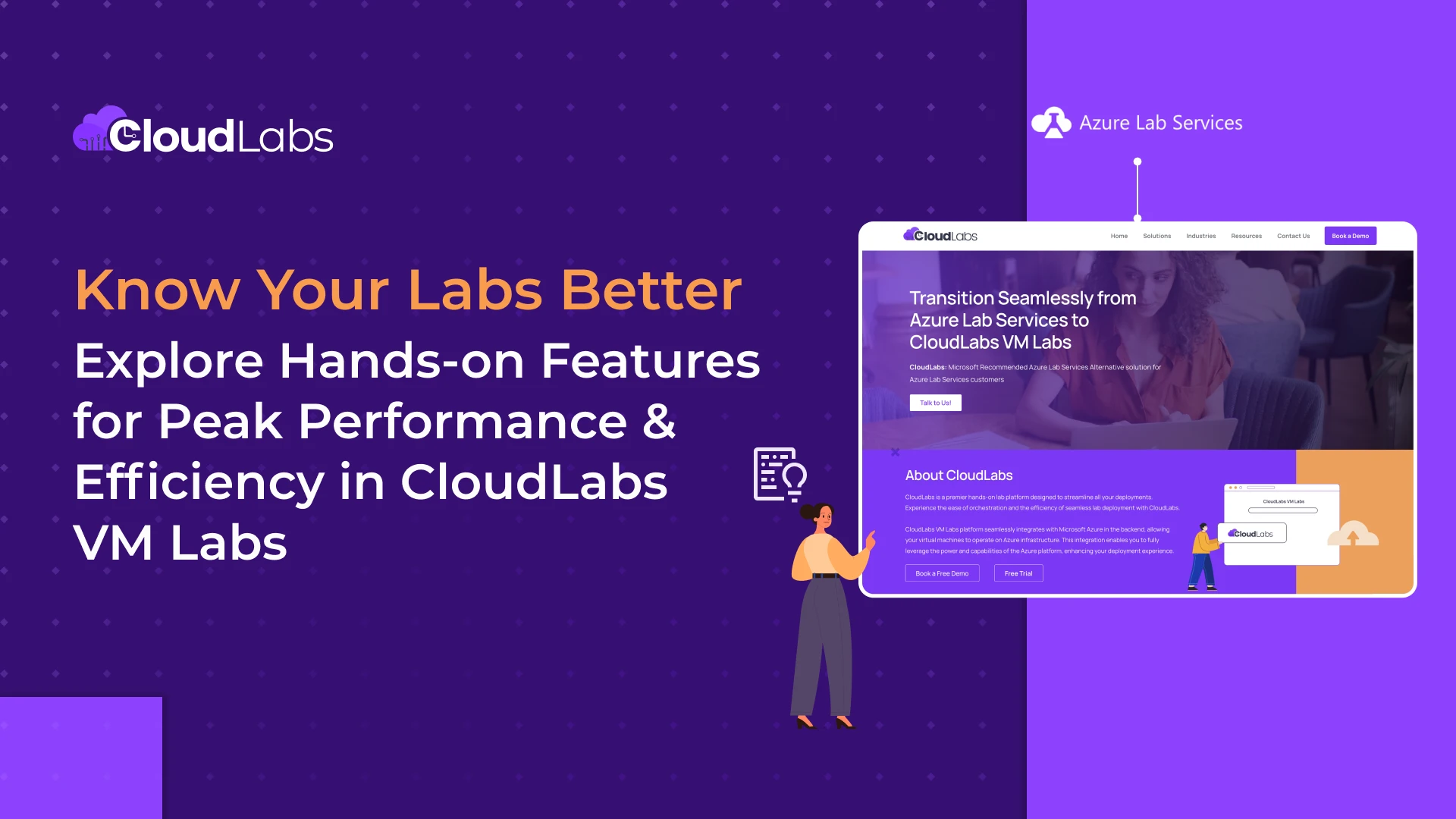 Azure Know Your Labs Better: Discover Hands-on Features That Will Help Maintain Optimal Performance and Efficiency Within CloudLabs VM Labs CloudLabs, as a trusted name in lab platforms, offers fully managed interactive lab solutions that are also innovative and reliable, fulfilling industry standards.